


Cyber attacks are becoming a regular feature in the headlines. From household names to smaller businesses, organisations are dealing with disrupted operations, exposed data and the challenge of rebuilding customer confidence.
It's easy to assume these attacks are aimed at large organisations with deep pockets. But that's no longer the case.
Today's cyber criminals aren't simply looking for the biggest targets; they're looking for the easiest ones. And for financial advisers, whose businesses are built on trust, that creates a unique challenge.
At Plannex, Parmenion's Head of Cyber & Resilience, Sarah Coles, shared why advisers are becoming increasingly attractive targets, how AI is changing the cyber threat landscape, and the simple steps firms can take to reduce their risk.
Cyber attacks aren't just about technology anymore
When people hear the phrase cyber attack, they often imagine hackers writing complex code to break into secure systems.
The reality is very different.
One of the biggest vulnerabilities today isn't technology. It's people.
Rather than attacking systems directly, cyber criminals are increasingly manipulating human behaviour through phishing, impersonation, social engineering and AI-generated content.
Financial advice firms are particularly attractive because they hold something incredibly valuable: trust.
Every day, advisers are trusted with clients' identities, pensions, investments and financial futures. If attackers can exploit that trust, they don't always need to break into systems to cause significant damage.
Why smaller firms shouldn't assume they're safe
One of the biggest misconceptions is that cyber criminals only target large organisations. In reality, many attacks are opportunistic.
Smaller firms often believe they're too small to be noticed, but attackers rely on exactly that assumption. Instead of targeting the largest businesses, they often look for organisations with weaker security controls or less awareness of evolving threats.
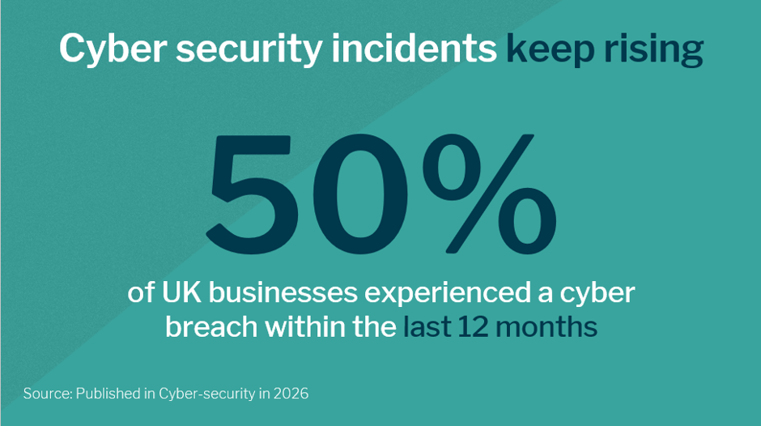
The scale of the problem continues to grow. Over the past year, around half of UK businesses reported experiencing a cyber attack or security breach, and many were targeted more than once. The volume of attacks shows that cyber crime has become a persistent business risk rather than an occasional IT issue.
AI is making cyber attacks far more convincing
Artificial intelligence has dramatically changed the cyber landscape.
The phishing emails filled with spelling mistakes and obvious warning signs are disappearing.
Today's AI tools can:
- write professional, personalised emails
- imitate someone's writing style
- clone voices
- generate realistic videos
- create convincing deepfake meeting participants
In other words, technology has significantly lowered the cost of deception.
Attackers no longer need exceptional technical skills to create convincing scams. AI allows them to produce highly believable communications at scale, making it much harder for people to distinguish genuine requests from fraudulent ones.
Why advisers are especially vulnerable
If a cyber criminal compromises an adviser's email account, they don't just gain access to information. They inherit credibility.
Imagine a client receives an email that appears to come from their trusted adviser. The language feels familiar. It references an ongoing piece of work. It asks the client to confirm bank details before a payment or transfer.
Many clients would have little reason to question it because it appears to come from someone they've trusted for years.
That's why impersonation attacks are becoming so effective. They're designed to exploit relationships, not just technology.
Six simple habits that significantly reduce risk
The encouraging news is that improving cyber resilience doesn't necessarily require a large IT department or significant investment.
Many successful attacks exploit basic weaknesses that are relatively straightforward to address.
Sarah recommends focusing on six simple habits:
- Use multi-factor authentication (MFA) to add an extra layer of protection to accounts. If you do one thing today, add MFA to your email and financial platforms.
- Stop and think before acting. Be cautious of unexpected emails, links or requests, even if they appear genuine.
- Use strong, unique passwords for every account, ideally managed through a password manager.
- Stay informed about emerging threats, including checking whether your email addresses have appeared in known data breaches, through sites like haveibeenpwned.com.
- Keep devices and software up to date so security vulnerabilities are patched quickly.
- Always verify high-risk requests, particularly changes to bank details, payment instructions or client information, using a separate trusted communication method.
Individually, each of these measures takes only minutes to implement. Together, they provide a significant improvement in your firm's cyber resilience.
Cyber security is about protecting trust.
Cyber security shouldn't be viewed as an annual compliance exercise or simply another IT responsibility. It's a daily habit.
Every conversation, every verification check and every security update helps protect the trust you've spent years building with your clients. Because while reputations often take decades to earn, they can be damaged in a matter of minutes.
Taking the basics seriously remains one of the most effective ways to protect both your business and your clients in an increasingly sophisticated threat landscape.
Stay informed with Sarah in her latest articles here.
This article is for financial professionals only. Any information contained within is of a general nature and should not be construed as a form of personal recommendation or financial advice. Nor is the information to be considered an offer or solicitation to deal in any financial instrument or to engage in any investment service or activity.
Parmenion accepts no duty of care or liability for loss arising from any person acting, or refraining from acting, as a result of any information contained within this article. All investment carries risk. The value of investments, and the income from them, can go down as well as up and investors may get back less than they put in. Past performance is not a reliable indicator of future returns.

